
Jonas Larroway was born in 1731 in Schoharie Co., NY. Elizabeth ‘Betsy’ Muller was born in 1735 or 1736, probably in what is now Germantown, NY. Her parents were among those who migrated from Germany in 1709-1710. They married in Schoharie in 1754.
During the American Revolutionary War, the family were Loyalists, colonists who opposed the Revolution.
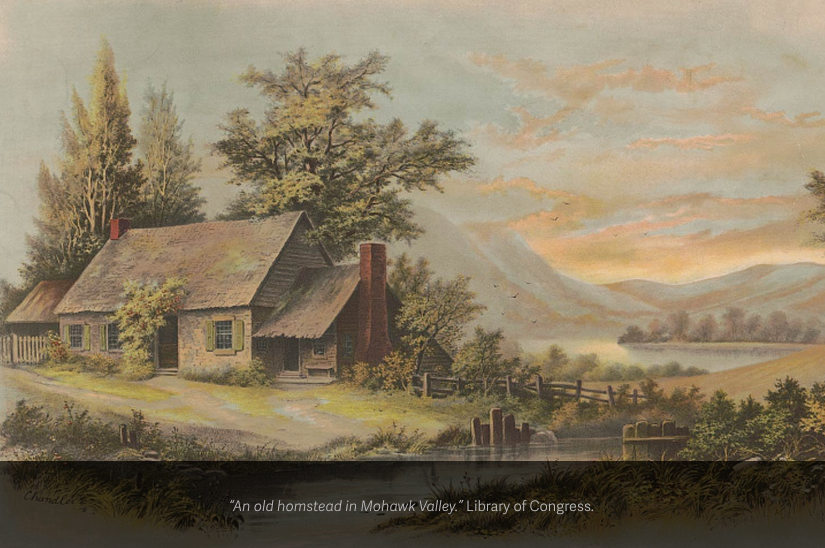
Jonas was a member of the celebrated (or infamous, depending on one’s point of view) Butler’s Rangers. Rangers recruits came mainly from the Mohawk Valley, New York. They were seldom beaten, and it was widely acknowledged that for “steadiness, bravery, and allegiance they were not to be excelled.” They were guerrilla fighters, and often the enemy scarcely knew of their presence until they attacked.
After the war, approximately 100,000 loyalists fled, many to Canada and some to England. The Larroways settled at Niagara, Ontario.
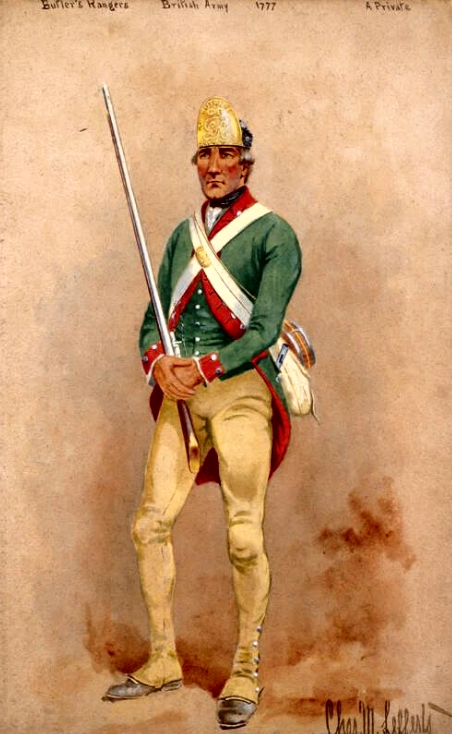
The Ranger Uniform
BUTLER’S RANGERS
Guerrilla armies were Britain’s most effective weapon in the American Revolution, and among the most notorious were the Butler’s Rangers.
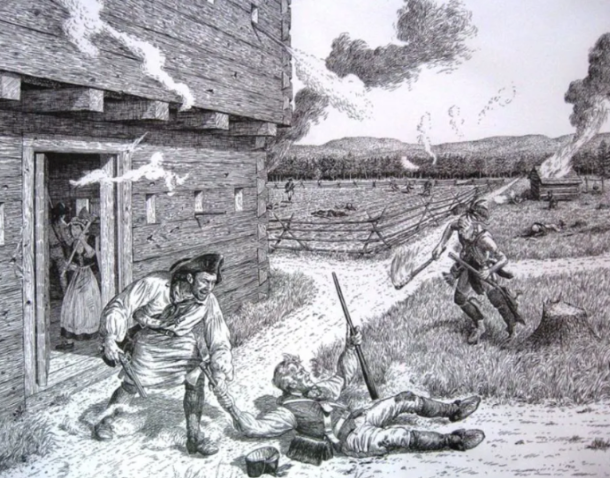
The Rangers were some 800 Loyalists and Native Americans who fought for Britain. They harassed and scalped rebels from the Hudson Valley to Kentucky. Their most notorious victory was an attack on Cherry Valley, NY (near present day Cooperstown) in the waning months of 1778.
Rumors of an attack on the settlement had been rampant. The townspeople begged to be allowed to store their valuables in the local fort, but American officers didn’t believe an assault was imminent. They were wrong. The descriptions of the day are full of confusion and horror. There were some forty homes in Cherry Valley. The final tally was seventy killed and thirty-three missing or captured.
When it was all over, a nameless individual wrote, I was never before spectator of such a scene of distress and horror. The first object that presented, was a woman lying with her four children, two on each side of her, all scalped. . . in all this massacre, there were but three men of the place killed, all the rest being helpless women and children. The Rangers were denounced by both sides for the brutality of the attack. In response, General Washington launched the Sullivan Expedition against the Iroquois in New York.
Butler’s Rangers were well paid. There are multiple dispatches in which Crown officers complained about the enormous expense of maintaining the Rangers as opposed to conventional regiments.
Rangers knew they could never go home, regardless of the war’s outcome. One said that they “would rather go to Japan than go back among the Americans.” Many moved to Canada after the war.
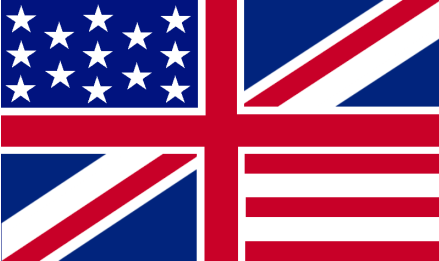
What if America had lost the Revolution?
We’ll never know, of course, but here are some reasonable conjectures:
- Slavery would’ve been abolished earlier. For all of the British Empire’s callous acts, British antislavery activists won the debate in their own country without having to fire a shot. In 1807, Parliament abolished the slave trade, and in 1833, it banned the owning of slaves in most of its colonial territories. If Britain had won, maybe there wouldn’t have been a US Civil War, in which more than 700,000 people died. This doesn’t mean that former slaves were treated as equals. The British also have a history of abusing people of color, but their history is less deadly than ours.
- Native Americans would’ve faced rampant persecution. But would they have been subjected to outright ethnic cleansing, such as the Trail of Tears ordered by President Andrew Jackson?
- America would have a parliamentary form of government, as Canada and Great Britain do today. Because of their structure, parliamentary democracies are less likely to face the gridlock that seems a permanent feature of modern governance in the United States.
- Eventually America would have become independent, as Canada is today.
More speculatively:
- Britain at that time wanted limits on western expansion in North America. Could this have led to creation of (a) separate nation(s) in America’s interior or on its west coast? Might Mexico have retained Texas and other parts of the Southwest and become a world power?
- Germany and Austria-Hungary, faced with a huge British Empire of which America was a part, might not have started a war in 1914.
- Would no World War I have meant no Bolshevik revolution, no Communism, no World War II?