
Jonathan Stout & Anna Bollen
Church goer. Anti-government rioter. Pirate-rescuer. Enslaver.
Jonathan Stout was a man of contradictions. He was a slave-owner with good relationships with the local Native Americans. He held public office at one point and rioted against the government at another. He was a church-goer who tried to keep a pirate out of jail.
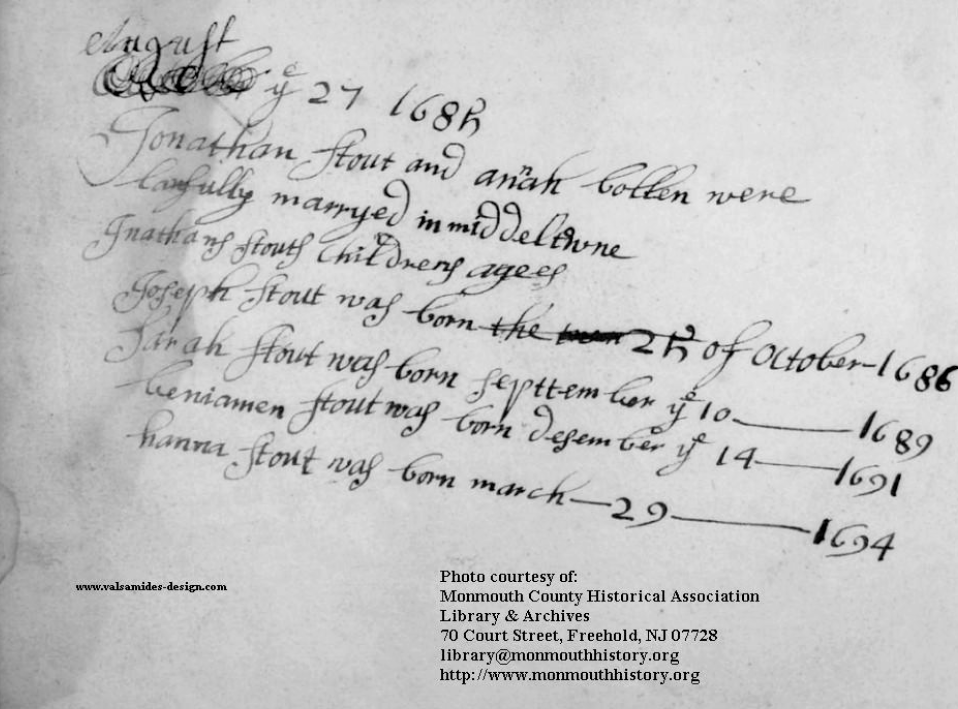
Jonathan was born about 1660 in Gravesend, Long Island, New York. He was very young when his family move to Monmouth County New Jersey. Anna Bollen was born about 1665, possibly on the ship bringing her parents to America, or possibly after they arrived. The couple married in 1685 and were among the first European settlers in the area of Hopewell New Jersey.

THE FIRST LAND GRAB
In 1664, Jonathan’s father, Richard, was among the settlers who bought land from the local tribes. In April, 1665, the Governor issued the Monmouth Patent, legally verifying their ownership.
But back in England, the mercurial King Charles II wasn’t concerned with legalities; in his mind, he owned everything by divine right; after all, God had made him king, hadn’t he? He gave to his brother a large swath of land that included the Monmouth Patent. What the locals didn’t know in 1665 was that the Governor had been replaced. News traveled slowly in the 17th century.
The new owners declared that deeds executed by the old Governor were null and void. They demanded rent. The colonists refused to pay. It took years before the two sides settled. And meanwhile, the locals’ anger at government support of the land grab kept building.
THE RIOTS
January 6, 2021 wasn’t the first time in America that an incensed mob stormed the government.
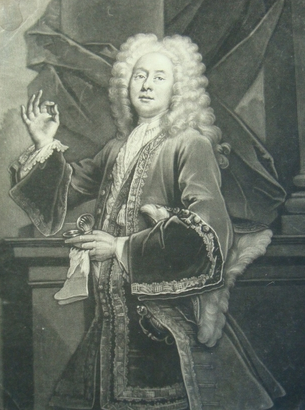
During the summer of 1700, citizens broke into local courts. In September, in one county, a crowd went so far as to pull off the wig of the court clerk and release all jailed prisoners. Then in 1701 came the trial of Moses Butterworth.
On March 25, 1701, Court convened in Middletown, New Jersey. The dignitaries took their seats. The prosecutor had a slam-dunk case. Moses Butterworth, accused pirate, had admitted sailing on the ship of Captain Kidd.
But as the trial got underway, a man named Samuel Willet appeared and shouted that the court had no authority.
Willet had enlisted a drummer to come along to make noise so that the court could not proceed. Thirty or forty local men, including Jonathan, then in his 40’s, all armed with clubs and arms, followed Willet.
The drum banged away as two men tried to release the prisoner. The sheriff fought them off and managed to subdue the troublemakers. The drum kept beating, and the crowd kept pouring up the stairs to the courtroom.
Judges and attorneys drew swords and tried to re-arrest the prisoner. The drum kept beating as the crowd assaulted the court officials and tore up court documents.
The drum kept beating, the crowd kept coming. The Rebels dragged off the dignitaries, threw them into cells and kept them there, under guard, from March 25 to March 29.
Yes, they actually put the Governor and other officials into jail. A witness claimed this was not a spontaneous uprising but “a Design for some Considerable time past.” Sound familiar?
WHY?
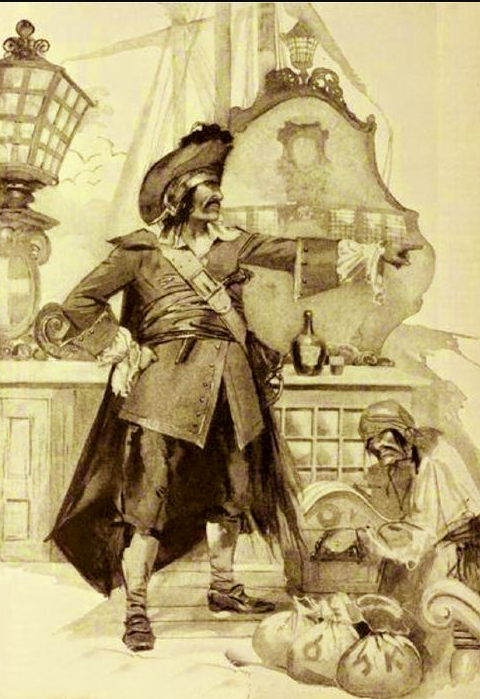
Why would these men take the side of a pirate? Pirate crew members were often ordinary farm boys recruited along the eastern American coasts. Lured by the promise of riches, they hoped to earn enough to buy land. They often returned to their communities and became respectable citizens. And pirates provided a useful service, bringing goods that the settlers needed and wanted, regardless of where they came from. Today we might say that they bought things that had fallen from the back of a truck.
There were less materialist reasons, too. Many colonists feared that the royal government’s crack-downs on piracy masked darker intentions to impose English authority, set up courts without juries of one’s peers, or even force the establishment of the English Church, the one they’d come to America to avoid.
ARGUMENTS AT THE DINNER TABLE?
Anna’s father James Bollen was the right hand man of the new and hated English Governor who had enabled the first land grab. Were Jonathan and Anna in political agreement, or was she just the dutiful wife? How did her father feel about the marriage? We’ll likely never know.
ANOTHER ENSLAVER
Jonathan was an enslaver. His will lists two Negro girls, valued at 20 pounds, and a Negro man, valued at 35 pounds. At the same time, his family was known for lifelong collegial relationships with the local Native Americans, maybe because of Jonathan’s grandmother Penelope’s experiences.
Jonathan died around 1722 in Hopewell, Mercer Co., NJ. Anna died about 1749.
SOURCES
- The story of the pirate was taken from “Stout Brothers Rescue a Pirate” by Vera Marie Badertscher. She writes so well that I copied much verbatim.
- A Lot of What Is Known about Pirates Is Not True, and a Lot of What Is True Is Not Known by Mark G. Hanna in HUMANITIES, Winter 2017, Volume 38, Number 1
- Ellis, Franklin, History of Monmouth County, 1885,
- Hanna, MG. (2015). “Well-Behaved Pirates Seldom Make History: A Reevaluation of the Golden Age of English Piracy.” In Governing the Sea in the Early Modern Era Essays in Honor of Robert C. Ritchie. UC San Diego. Report #: 5. Retrieved from https://escholarship.org/uc/item/9j63k6xp in June and July 2021.
- Stillwell, John, M.D., Historic and Genealogical Miscellany : Data Relating to the Settlement and Settlers of New York and New Jersey, Vol. IV , New York, NY: Self-published, 1903. T