
Joseph Stout was born in 1686 in Middletown, Monmouth NJ. Ruth Brinson was born around the same time in in Bucks County PA. They married as teenagers in 1705. Their firstborn, John, is our ancestor.
THE SECOND LAND GRAB
In the mid 1680’s, Daniel Coxe, a physician to the royal family of England, purchased 30,000 acres in New Jersey. In 1692, he sold much of it to a London stock company. Unfortunately, the company failed to register the sale.
As time passed, settlers arrived and bought land from the stock company. Deeds were issued, homes and barns built. But in 1731, his son, also named Daniel Coxe, claimed that the land had not been sold to the stock company — it was still his. As has happened often through history, the local court sided with the well-connected family. The settlers were ordered to pay or to be evicted.
Fifty settlers, including Joseph, filed a countersuit. But again, the settlers lost
Joseph Stout was financially successful, and he was able to buy back his land from Coxe. Others weren’t so fortunate. Some evictees were so enraged by the injustice that they broke into their former homes and tarred and feathered the occupants.
THE VERY BIG HOUSE
The Stouts were fervent Baptists. In 1747, when it was time to build a church, Joseph offered land. But it wasn’t centrally located, and the congregation chose to build elsewhere. Joseph, feeling insulted, vowed to build a home bigger than the church, and he did.
The Stout mansion was built in the Georgian style in 1752. It was a large stone house, two stories, nine rooms, six fireplaces, a large central entry hall, a cellar, a cellar kitchen, a well of excellent water at the door, a stone barn, other outbuildings, and an orchard of fruit trees.
In June of 1778, during the Revolutionary War, this home was used by George Washington as headquarters as he prepared for the Battle of Monmouth. That battle was irrelevant; neither side landed the decisive blow they had hoped for. But the improved performance of the American troops allowed Washington to present the battle as his triumph.
The house still stands and can be found here.
WE COULD BE SPEAKING FRENCH RIGHT NOW
The French and Indian War (1754-1763) was fought by the French and their Indian allies against the English and their Indian allies, to see which European nation would rule North America.
At the outbreak of the war, about 3,000 European settlers lived in the Upper Delaware River Valley between Pennsylvania and New Jersey. Joseph was appointed Colonel of the local militia. In late 1755, when he was almost 70, he led 300 men to successfully protect those settlements. Ultimately, the British won the war. The terms of peace stripped France of nearly all of her North American possessions.
ENSLAVER
Hopewell New Jersey was a town that practiced slavery. The 1778 census, which includes only adult male slaves, lists about 50. Some of them were members of the Stouts’ Baptist Church; whether that was their choice or their owners’, we don’t know.
Joseph’s will says:
My wench, Kate, formerly belonging to my mother-in-law Horner, shall be free after the death of my wife, and to be property of Weynam, a mulatoo man, formerly belonging to Mr. Horner above said, as his wife.
He died in 1766 and she died in 1768, both in Hopewell NJ.
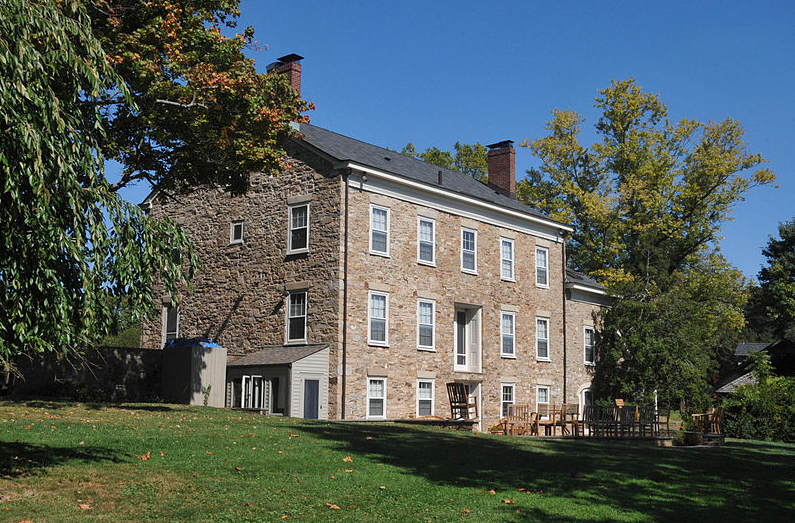
The Stout House
TARRING AND FEATHERING
Tarring and feathering waa a public punishment used for unofficial justice or revenge. In the American colonies, it was mostly a type of mob vengeance.
The necessary materials were easily available to the average citizen. The victim would be stripped naked or to the waist. Wood tar was then poured or painted onto the body. Finally, feathers were thrown on the victim, or he was rolled on a pile of feathers so that they stuck to the tar.
in most cases, tarring and feathering was meant to humiliate, not kill. Pine tar was commonly used. With a melting point of around 130-140 degrees Fahrenheit, it would be very uncomfortable, but nothing like the harm that would be caused by melted petroleum-based tar.
The last known tarring and feathering in the United States was in Alabama in 1981. The victim was to be married that day, and her fiance’s ex-wife didn’t like it. But she cleaned herself up as best she could, and the wedding went on as scheduled.
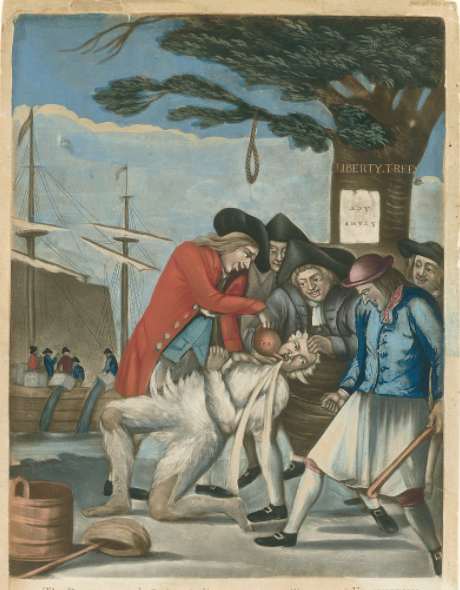
Tarring & Feathering
Sources:
- HOPEWELL’S PAST by Betty Gantz
- “Pioneers of Old Hopewell”, Ralph Ege, 1908
- Historical and genealogical miscellany, Stillwell, John Edwin, 1916
- “History of the Stout Family”, Nathan Stout, 1823
- Somerset Historical Quarterly’ William Benedict, page 289
- http://www.todayifoundout.com/index.php/2015/04/happens-someone-tarred-feathered/
- https://en.wikipedia.org/wiki/Tarring_and_feathering